

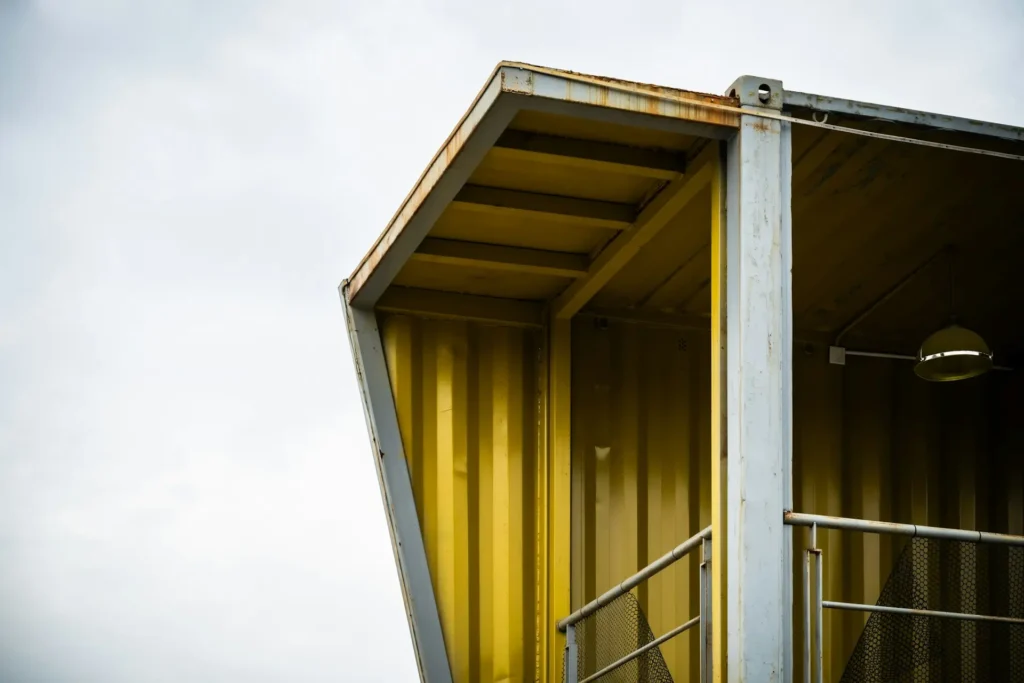
Reimagining what buildings can be, and how quickly they can be built.
Modular construction using shipping containers and prefabricated structural systems is transforming how Nigeria builds. In a country where conventional construction is slow, expensive, and quality-inconsistent, modular construction offers a compelling alternative: faster delivery, more predictable costs, and structural performance that matches or exceeds conventional buildings, provided the structures are properly engineered.
Masterstone Engineering Ltd. provides specialist structural design services for container buildings and modular structures in Nigeria, from single-container site offices to multi-storey container hotels, residential blocks, and educational facilities. We bring engineering rigour to an innovative construction method that demands it.
What is Container & Modular Construction?
Container construction uses ISO shipping containers (typically 20-foot or 40-foot) as the primary structural module of a building. Containers are inherently strong, being designed to be stacked nine high when fully loaded at sea, but their structural performance changes significantly when openings are cut, they are stacked in building configurations, and they are subjected to building loads rather than shipping loads.
Modular construction more broadly refers to any building system where volumetric or structural modules are fabricated off-site and assembled on site, reducing construction time and improving quality control.
Our Container Structure Design Services
Structural Design of Container Buildings
We assess the structural implications of every modification made to shipping containers in a building application, cutting openings, removing walls, welding modules together, and adding floors, and design the required structural reinforcement and supplementary framing to ensure the building performs safely.
- Single-storey container structures (site offices, retail units, clinics)
- Multi-storey container buildings (hotels, apartments, student housing)
- Container café, retail, and hospitality structures
- Container classrooms and school facilities
- Mixed container-and-conventional hybrid structures
Foundation Design for Container Buildings
Container buildings are typically lighter than conventional construction, but they still require properly designed foundations. We design foundations for container buildings based on site-specific geotechnical data, ranging from simple concrete strip footings for single-storey structures to bored pile foundations for multi-storey container buildings on soft ground.
Inter-Module Connection Design
The connections between individual container modules, both horizontal (module-to-module) and vertical (stacking connections), are critical structural elements. We design and detail these connections for the full range of structural loads, including wind uplift, lateral loading, and differential thermal movement.
Structural Modification Design
Almost every container building requires structural modifications, large openings for doors and windows, removal of corrugated side panels, addition of mezzanine floors or staircases. We design the structural reinforcement (typically C or Z section steel frames) required to restore structural integrity after each modification.
Advantages of Container Construction in Nigeria
- Speed: container structures can be assembled in weeks rather than months
- Cost: when properly planned, container construction is cost-competitive with conventional building for certain building types
- Quality: factory-fabricated modules offer better dimensional accuracy than site-built construction
- Flexibility: containers can be relocated if business needs change
- Sustainability: repurposing used shipping containers reduces material waste